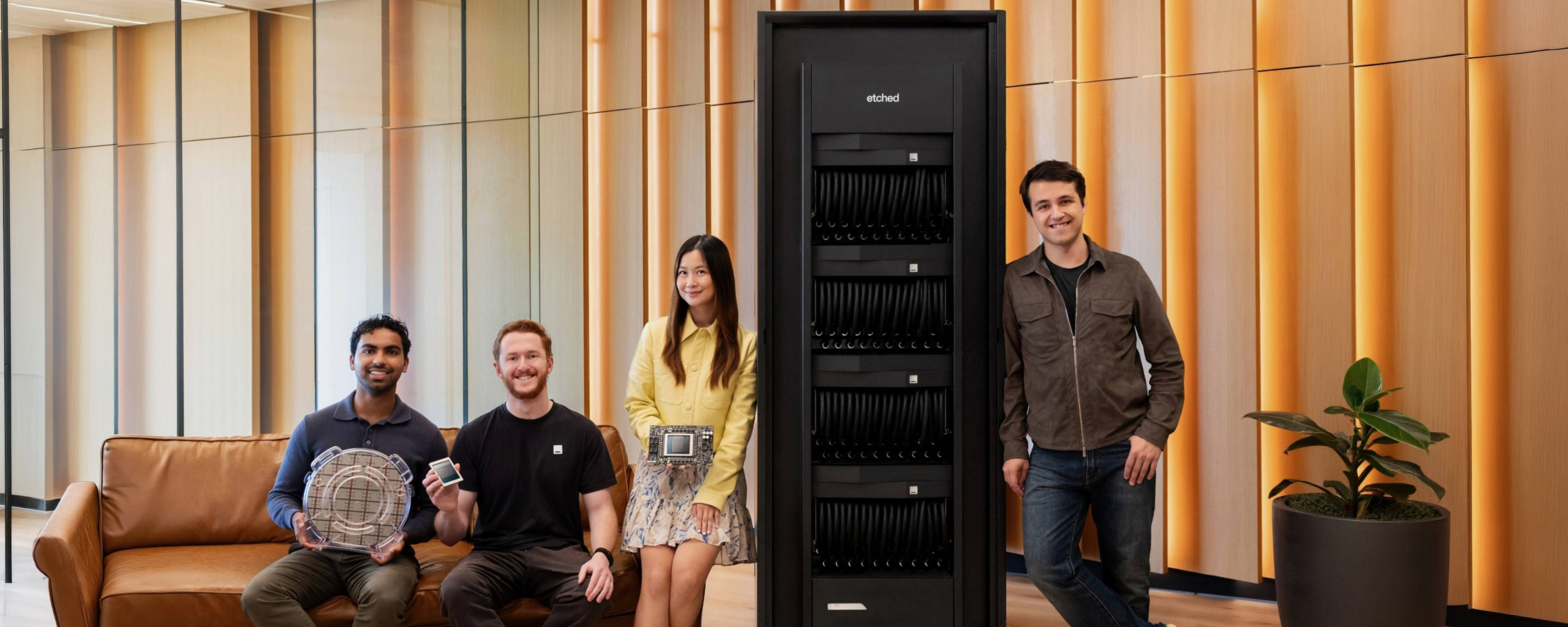
Etched, a hardware startup emerging in the post-ChatGPT era, is setting a new benchmark in the inference market with its production-ready custom silicon designed to accelerate AI model processing.
In an era where AI's capabilities are rapidly expanding, Etched's innovations in low voltage inference and cluster-scale memory are particularly significant. These advancements not only enhance computational throughput and latency but also represent a critical step in addressing the growing demand for AI-driven applications across multiple industries, from retail to healthcare.
Indeed, the inference market is poised to become one of the largest globally, and Etched's pioneering efforts are at the forefront of this transformation. The company’s ability to build cluster-scale inference systems marks a departure from traditional chip-focused designs, reflecting a shift towards more holistic computational approaches. As the unit of compute has evolved from chips to clusters, Etched's custom silicon is uniquely positioned to support the varied and complex AI models now in development.
The implications of Etched's technological strides extend beyond mere computational efficiency. By enhancing the hardware infrastructure necessary for AI applications, the company is indirectly influencing employment patterns in sectors reliant on AI advancements. Jobs in IT and systems engineering are likely to evolve, as professionals in these roles adapt to new technologies and seek to integrate Etched's innovations into existing frameworks. Moreover, as AI systems become more ubiquitous, industries such as entertainment, medicine, and legal services may see a transformation in job roles, with a growing emphasis on managing and interpreting AI-driven outputs.
Furthermore, Etched’s rapid development milestones—such as its successful chip tape-out at TSMC and the establishment of its first chip cluster—demonstrate the company's potential to drive significant changes in AI technology and its application in real-world scenarios. This momentum suggests that the demand for skilled workers capable of navigating these advanced systems will only increase, leading to the emergence of new job opportunities focused on optimizing and deploying AI solutions.
Looking ahead, the next 12 to 24 months are likely to witness a continued expansion of Etched's influence on the AI hardware landscape. As the company scales its production capabilities and expands its market reach, the ripple effects on employment will become more pronounced. Workers in tech-related fields will need to adapt swiftly to the changing technological environment, acquiring new skills and knowledge to remain competitive.
In conclusion, Etched is not merely building a machine; it is crafting the future of AI infrastructure. As this journey unfolds, the employment landscape will inevitably change, offering both challenges and opportunities for those willing to adapt.
Originally reported by Sequoia Capital