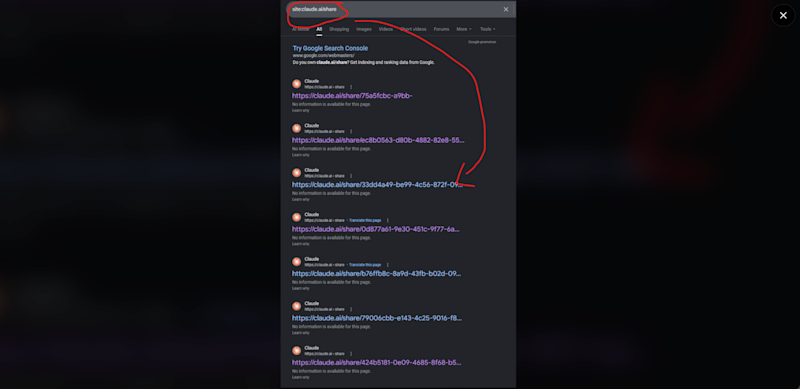
The recent revelation that certain conversations and artifacts shared on Anthropic's Claude AI are being indexed by Google Search raises both privacy alarms and economic questions. As enterprises increasingly turn to AI for collaboration, such vulnerabilities could reshape employment landscapes.
This incident underscores the precarious balance between technological advancement and job security. As companies like Anthropic offer sophisticated AI tools for creating and sharing business assets, they inadvertently expose sensitive data to public access, potentially undermining trust in AI-driven workplace solutions.
The implications for employment are manifold. On one hand, AI tools such as Claude are designed to enhance productivity by facilitating collaboration across digital platforms. For instance, the ability to share interactive applications and dashboards can streamline workflows and enable remote teamwork. However, the recent exposure of these artifacts to public search engines could deter businesses from fully adopting such technologies, fearing potential data breaches.
Moreover, the incident highlights a critical challenge in AI deployment: ensuring robust data security while maintaining accessibility. As digital transformation accelerates, workers must adapt to new tools and workflows, often without the assurance that their data remains private. This unease can stifle innovation and slow down the integration of AI in day-to-day operations.
Indeed, the economic theory of creative destruction suggests that while technological disruptions can initially displace jobs, they also pave the way for new roles and opportunities. However, the transition is fraught with uncertainty, particularly when trust in technology is compromised. Employees and companies alike may be reluctant to embrace AI if privacy concerns are not adequately addressed.
In the next 12 to 24 months, enterprises may demand more stringent security measures from AI providers like Anthropic. Workers involved in AI-driven projects will need to be more vigilant about data handling, further blurring the lines between traditional job roles and responsibilities.
Ultimately, while AI promises to revolutionize the workforce, incidents like the Claude exposure remind us of the vulnerabilities that accompany digital progress. As businesses navigate this evolving landscape, balancing innovation with security will be paramount.
Originally reported by VentureBeat