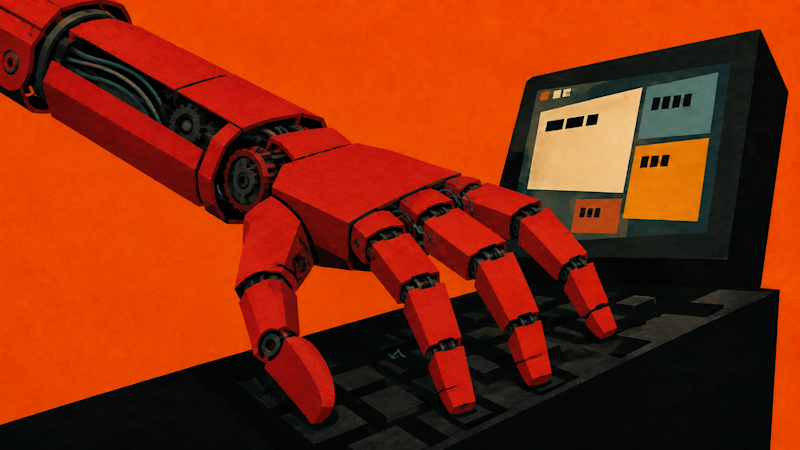
AI startup Hark has launched its first product, Handoff, a computer use agent (CUA) designed to autonomously navigate the web on behalf of users. Announced by the company this week, Handoff is now open for public sign-ups at hark.com, with a planned release later this month.
Handoff is capable of performing tasks such as ordering food via DoorDash, booking flights with airlines like United and Delta, and messaging job candidates on LinkedIn, all without human intervention. Hark claims that Handoff has achieved the highest score on the Online-Mind2Web (OM2W) benchmark, a third-party leaderboard for web agents, with a score of 97.7. This surpasses the scores of other models like OpenAI's GPT 5.4 and Google's Gemini 2.5 Pro. Handoff is also noted for its cost efficiency, offering services at a fraction of the price of competing models, with input and output token costs significantly lower than those of GPT 5.5.
Technically, Handoff initiates a dedicated virtual computer for each request, complete with its own browser, file system, and terminal. Users can link their existing accounts, allowing the agent to utilize saved addresses and payment methods. Hark's approach to training involves supervised fine-tuning followed by asynchronous reinforcement learning using the GRPO algorithm, although specifics about the training data are not disclosed.
Handoff is targeted at a wide range of users, from individual consumers to enterprises. It is particularly suited for tasks that involve extensive web navigation and interaction, such as e-commerce and recruitment processes. The product is showcased in a video demonstration where it autonomously completes a purchase on a florist's website.
Work implications: Handoff could streamline roles that involve repetitive online tasks, potentially enhancing productivity in areas like customer service and recruitment by automating routine web interactions.
Originally reported by VentureBeat