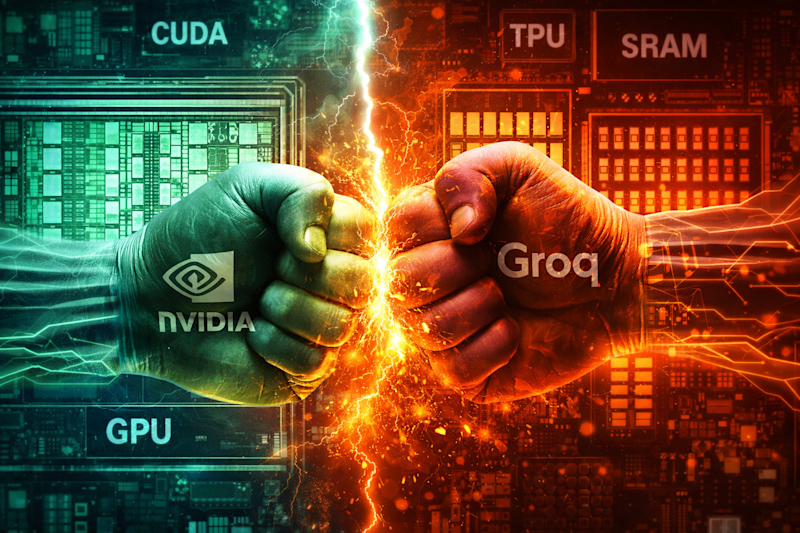
Nvidia's recent $20 billion strategic licensing agreement with Groq marks a pivotal moment in the evolution of AI hardware, showcasing a shift away from traditional general-purpose GPUs towards a more disaggregated inference architecture.
This move is not just a technological progression; it's a reflection of the changing demands in the field of AI and machine learning. As AI becomes an integral part of enterprise operations, the need for specialized hardware that can handle massive data processing and instantaneous decision-making becomes paramount. This transition holds significant implications for employment, particularly in sectors reliant on data-intensive tasks.
The current landscape reveals that inference, the phase where AI models are actually executed, has started to generate more revenue than the training phase within data centers. This shift, termed the 'Inference Flip,' necessitates new hardware solutions that can accommodate the distinct requirements of prefill and decode phases in AI tasks. This separation is crucial because it reflects the industry's understanding that one-size-fits-all solutions, like traditional GPUs, are no longer sufficient.
Indeed, Nvidia's partnership with Groq highlights a strategic pivot to maintain its market dominance. The Vera Rubin chip family, for instance, is Nvidia's answer to the need for handling vast context windows efficiently, capitalizing on the less costly GDDR7 memory. At the same time, Groq's influence brings SRAM into the spotlight, offering a robust solution for minimizing energy use during data transfers, which is critical in maintaining the efficiency of AI applications.
Moreover, this development can potentially reshape job markets, particularly those involved in AI hardware production and integration. As specialized AI chips become prevalent, we may see a surge in demand for roles focused on developing and implementing these innovative technologies. The focus will likely be on optimizing design and functionality to adhere to the evolving standards of AI proficiency.
Looking ahead, the next 12-24 months could bring about significant transformations in how workers in AI-reliant industries adapt to changing technological infrastructures. Companies might need to invest in retraining their workforce to equip them with skills pertinent to deploying and maintaining the new architecture effectively.
In conclusion, Nvidia's investment strategy with Groq not only underscores the unfolding changes within the AI hardware sector but also mirrors broader employment trends, suggesting a future where technology continuously redefines job roles and market dynamics.
Originally reported by VentureBeat