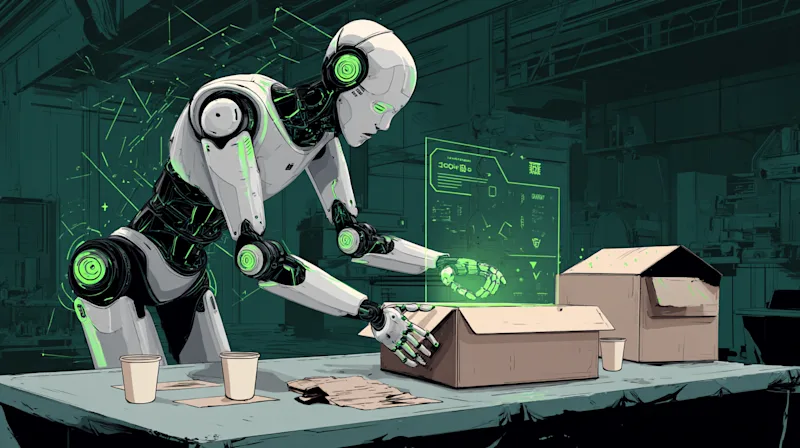
Nvidia's launch of DreamDojo marks a transformative step in robotics, unveiling a new AI system trained on 44,000 hours of human video to teach robots how to navigate the physical world. This innovation could significantly lower the time and expenses associated with training humanoid robots, a crucial development for industries poised to adopt automation.
The implications for employment are profound, as DreamDojo's capabilities promise to accelerate the deployment of robots in manufacturing and other sectors. As industries grapple with labor shortages and rising operational costs, the ability to quickly train robots to perform complex tasks could lead to a significant reconfiguration of the workforce. The traditional bottleneck of requiring extensive robot-specific data is sidestepped, allowing for faster integration of AI-driven machines into the workplace.
Moreover, Nvidia's system demonstrates a novel approach to robot training. By utilizing a large-scale video dataset, DreamDojo can generalize across diverse environments and objects, making it adaptable to various industrial applications. This adaptability is crucial as companies like Tesla and Siemens explore robotics to enhance productivity. Furthermore, the system's real-time interaction capabilities, achieved through a distillation process, enable practical applications such as live teleoperation, expanding the potential use cases for these machines.
Indeed, the economic stakes are considerable. With capital expenditures in AI infrastructure potentially reaching $660 billion this year, according to industry data, the push for robotics is reshaping investment priorities. The AI industry's rapid growth is mirrored by record-breaking funding for robotics startups, which collected $26.5 billion last year. This financial momentum underscores the strategic importance of robotics for companies aiming to maintain competitive advantages in an increasingly automated world.
As DreamDojo facilitates more efficient robot training, the impact on employment will likely be twofold. On one hand, existing roles may transform as human workers collaborate with AI-enhanced machines. On the other, new job categories may emerge, focusing on system maintenance, programming, and oversight. For workers, the next 12 to 24 months could see a shift towards roles that emphasize human-robot interaction, as well as an increased demand for skills in AI management.
Ultimately, Nvidia's DreamDojo represents a pivotal advancement in robotics, potentially redefining the landscape of industrial labor. As AI continues to evolve, the balance of human and machine work will be a central narrative in the future of employment.
Originally reported by VentureBeat.