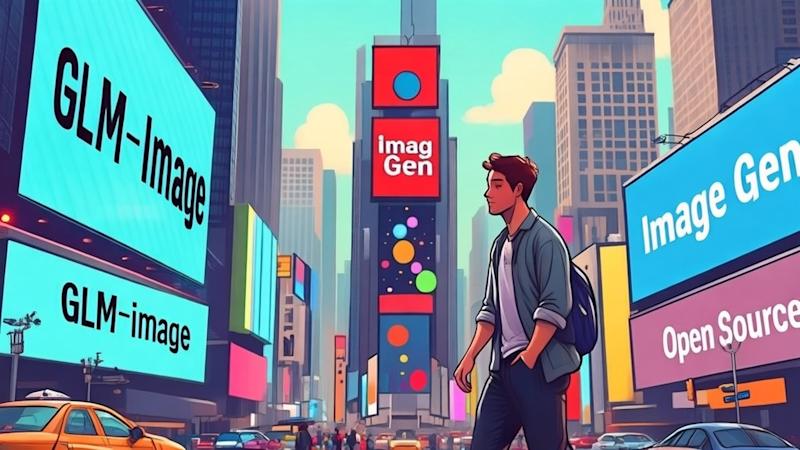
In a significant development within the world of artificial intelligence, Z.ai's open-source GLM-Image has outperformed Google's Nano Banana Pro in complex text rendering, marking a notable shift in the landscape of AI-driven image generation. This advancement, however, underscores broader implications for employment in creative industries, where AI continues to redefine roles.
The emergence of GLM-Image is not merely a technical achievement; it represents a potential inflection point for businesses reliant on visual content production. As AI models like GLM-Image become more sophisticated and accessible, they promise to reduce costs and streamline processes in sectors such as marketing, education, and publishing. Here, the stakes are high, as the ability to generate precise and information-dense visuals could reshape job functions traditionally held by graphic designers and content creators.
The GLM-Image model, with its 16-billion parameter architecture, diverges from the conventional diffusion models commonly used in the industry by adopting a hybrid auto-regressive and diffusion approach. This innovation allows the model to excel in generating text-heavy visuals, boasting a Word Accuracy average of 0.9116 on the CVTG-2k benchmark. In contrast, Google's proprietary Nano Banana Pro scored 0.7788, highlighting the open-source model's superior semantic control. Nevertheless, the GLM-Image's aesthetic appeal still lags behind, as evidenced by the OneIG benchmark results.
Moreover, the shift towards open-source models poses questions about the future of proprietary AI tools. While Google's Nano Banana Pro benefits from integration with its extensive search capabilities, offering users unparalleled access to real-time data, Z.ai's model provides a cost-effective alternative that could democratize access to advanced AI, particularly for small to medium enterprises. This democratization could lead to a more competitive market, where businesses leverage AI not just to enhance productivity but also to innovate creatively.
Indeed, the growing adoption of AI in image generation aligns with broader employment trends, where automation and digital transformation are reshaping the workforce. As machines take on more complex tasks, the demand for traditional design roles may decline. However, this also opens up opportunities for new job categories focused on AI model training, data curation, and system customization, ensuring that workers who adapt can thrive in an AI-enhanced economy.
Looking forward, the next 12 to 24 months could see an acceleration of these trends. Companies might increasingly opt for open-source solutions like GLM-Image for their flexibility and cost advantages. This shift could lead to a reallocation of resources, with businesses investing in human skills that complement AI capabilities, such as strategic oversight and creative direction.
In conclusion, while Z.ai's GLM-Image may not yet match Google's AI offerings in every aspect, its performance in text rendering positions it as a formidable player in the AI landscape. As industries adapt to these technological shifts, the nature of work will inevitably transform, challenging workers to embrace new roles and opportunities shaped by AI's expanding capabilities.
Originally reported by VentureBeat.