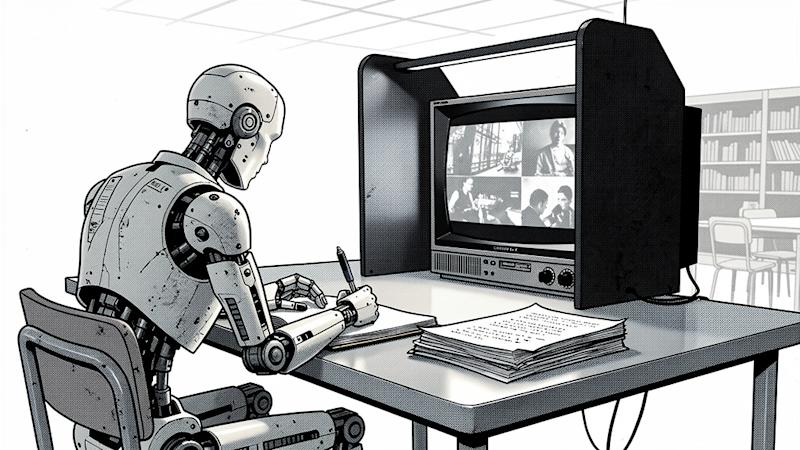
In a bold stride towards AI advancement, Chinese AI startup Zhipu AI has unveiled its GLM-4.6V series, an open-source vision-language model poised to redefine multimodal reasoning capabilities. This development, standing at the forefront of AI innovation, promises to transform how visual and textual data interact, opening new vistas in technology and employment.
The release of GLM-4.6V arrives at a critical juncture where AI's role in the labor market is both scrutinized and celebrated. As companies increasingly adopt automation to enhance productivity, the demand for AI-related skills is surging. This trend is not merely about replacing human roles but about reshaping them, creating opportunities in AI development, deployment, and maintenance.
Zhipu AI's innovation is marked by its introduction of native tool-calling capabilities within its vision-language model—a first in the field. The GLM-4.6V series, available in both large and small configurations, offers versatility for cloud-scale and local applications. With this, Zhipu AI positions itself as a formidable competitor in the VLM landscape, challenging both proprietary and open-source models. The larger model, with its 106 billion parameters, is designed for high-efficiency deployment, while the smaller variant caters to environments where latency and resource constraints are paramount.
Moreover, the series' open-source nature under the MIT license underscores its potential for widespread enterprise adoption. Organizations can integrate these models into proprietary systems, facilitating new roles in AI integration and governance. This aspect is crucial for industries seeking to maintain control over their infrastructure while leveraging cutting-edge AI technology.
Indeed, the GLM-4.6V's architecture—featuring a Vision Transformer encoder and a sophisticated decoding system—enables it to handle diverse inputs, from static images to dynamic video frames. This capability not only enhances its application in sectors like healthcare, where visual data is abundant, but also in fields such as finance and logistics, where rapid data interpretation is crucial.
In the next 12 to 24 months, as businesses increasingly harness these AI tools, the workforce will see a shift. Roles in AI management, data analysis, and system optimization are set to expand, offering new career paths for those with the requisite skills. Workers will need to adapt, learning to collaborate with AI systems rather than compete against them.
As we look to the future, Zhipu AI's GLM-4.6V stands as a testament to the transformative power of AI. It heralds a new era where AI-driven tools not only enhance efficiency but also forge new employment landscapes, challenging traditional notions of work and productivity. Originally reported by VentureBeat.